


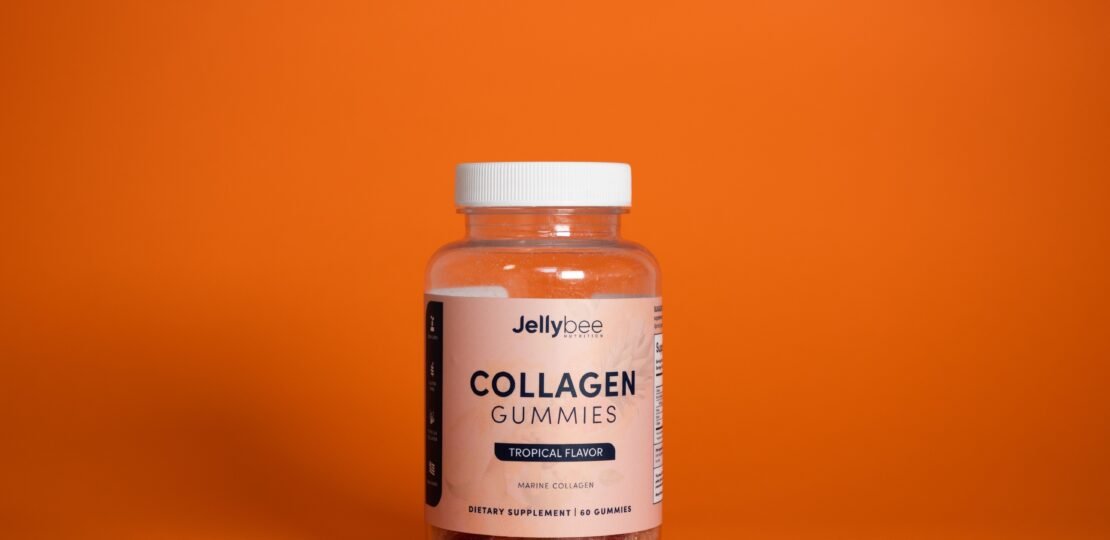
I take collagen. I have for years, and I think it has helped. I also want to be straight with you about how modest and how uncertain the evidence is, because you are being sold this product very hard right now.
This is the article on this site closest to something I may earn a commission on. That makes it the one where I owe you the most honesty, so let me start with the least commercial thing I can say: a meaningful number of women reading this do not need it.
What collagen actually is
Collagen is the most abundant protein in your body — the structural scaffolding in skin, tendons, ligaments, cartilage and bone. Production begins declining in your twenties and drops more sharply after menopause.
Supplements are usually hydrolysed collagen, meaning it has been broken into shorter fragments called peptides so it can be absorbed.
The thing most articles get wrong
Eating collagen does not send collagen to your skin. Your digestive system breaks all protein down into amino acids and peptides, and your body then builds whatever it needs from that pool. There is no delivery address on the label.
The more interesting hypothesis is that certain collagen peptides may act as a signal — that their presence in the bloodstream prompts cells to increase their own collagen production. That is plausible, it has some supporting evidence, and it is not settled.
There is no delivery address on the label. Your body breaks it down like any other protein.
What the evidence supports
- Skin elasticity and hydration. This is the strongest area. Several randomised trials show modest improvements over eight to twelve weeks. Modest is the operative word — measurable, not transformative.
- Joint discomfort. Some evidence for reduced activity-related joint pain, particularly in athletes and in osteoarthritis. Effects are again small to moderate.
- Bone density. Early and interesting, particularly in postmenopausal women, but the studies are fewer and smaller.
A fair summary: real effects, small effects, and a research base that is nothing like as mature as the marketing implies. Many trials are also funded by supplement manufacturers, which does not invalidate them but is worth knowing.
What it will not do
- It will not reverse deep wrinkles or replace sun protection. Nothing you swallow competes with sunscreen.
- It will not rebuild cartilage that is already gone.
- It is not a complete protein — it lacks tryptophan — so it should not be counted as your main protein source.
- It will not do much at all if the rest of your diet is short on protein and vitamin C, which your body needs to make collagen in the first place.
If you already eat adequate protein — roughly a palm-sized portion at each meal — and plenty of vitamin C, you may see very little. Collagen supplementation appears to help most in people who are short on protein, older, or dealing with a specific joint or skin concern.
Before spending money here, it is worth asking whether you would get more from simply eating more protein. For many women, the answer is yes.
If you decide to try it
- Dose. Most positive trials used 2.5–15g daily. Ten grams is a reasonable middle.
- Type. Types I and III are associated with skin; type II with joints. Many products blend them.
- Give it twelve weeks. Skin turnover is slow. Judging at three weeks tells you nothing.
- Pair it with vitamin C, which is required for collagen synthesis. A supplement taken with fruit does this for free.
- Look for third-party testing — NSF or Informed Choice. Supplements are loosely regulated and contamination is a real issue.
You are pregnant or nursing, have a history of kidney disease, or have allergies to fish, shellfish or eggs, since collagen is commonly derived from those sources. Collagen is not medication, but “natural” does not mean “fine for everyone.”
Where I land
I take it, and I would not want to oversell it to you. It is a reasonable addition for a woman in or past perimenopause who already eats well and wants to support skin and joints at the margins.
It is a poor substitute for eating enough protein, sleeping properly, and staying out of the sun without protection. If you can only change one thing, change one of those first.
The products I actually use.
Everything in my shop is something I use myself, with an honest note on what it does and does not do.
Some links on this site are affiliate links. I only recommend products I use, and my opinion of them is not for sale.
RELATED POSTS
View all